Week 1 Self-Reflective Assignment: Connect Research Theory to Practice
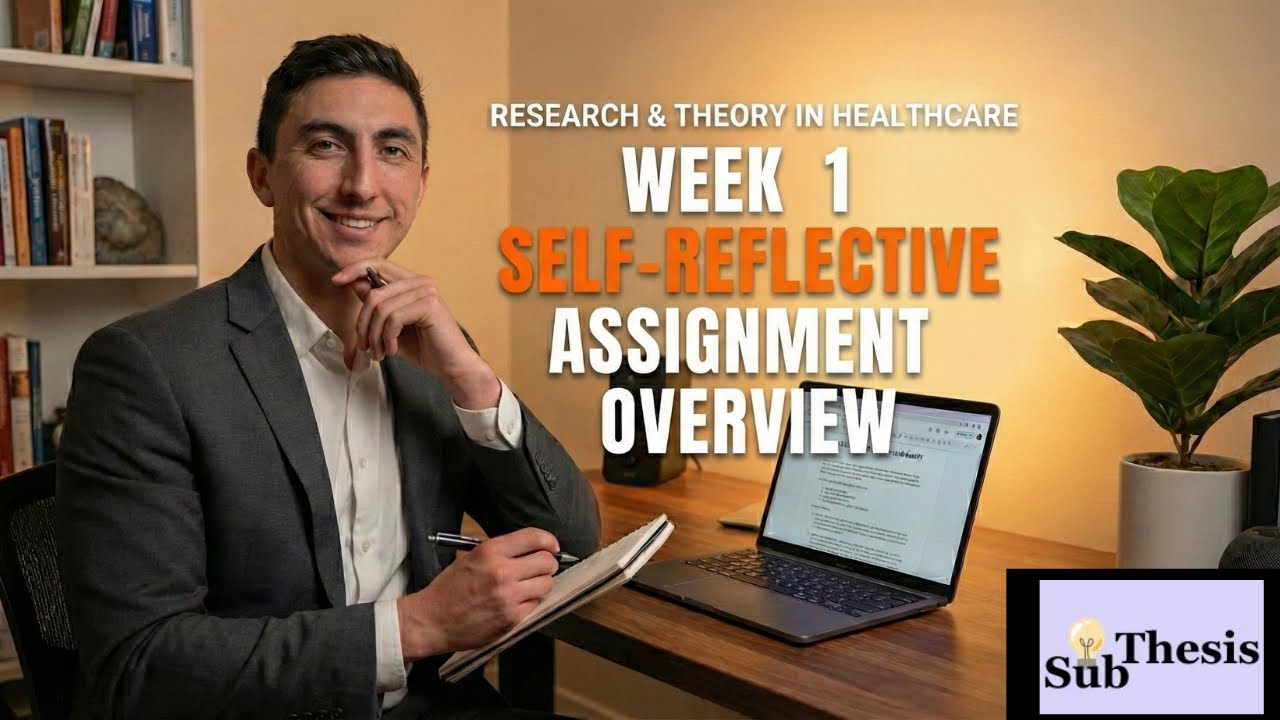
The Value of Reflective Writing in Research Education
Reflective writing occupies a unique space in healthcare education because it asks learners to turn the analytical lens inward. Rather than summarizing external content, you are examining your own assumptions, experiences, and evolving understanding of research. This metacognitive process strengthens learning in ways that passive note-taking cannot achieve.
In the context of a research course, reflection serves a dual purpose. First, it reveals your starting point—what you already believe about knowledge, evidence, and professional practice. Second, it creates a documented baseline against which you can measure intellectual growth as the course progresses. Many students are surprised to discover how much their perspectives shift over just a few weeks of structured study.
Healthcare disciplines have long recognized reflective practice as a professional competency. Nursing theorists such as Johns and Gibbs developed structured reflection models precisely because practitioners who examine their reasoning make fewer errors and adapt more effectively to novel situations. Your reflective assignment draws on this same tradition.
Assignment Structure and Formatting Expectations
The Week 1 reflection is a concise 2-3 page paper, typically formatted in APA style unless your instructor specifies otherwise. This length constraint is intentional: it forces you to be selective and precise rather than exhaustive. Every sentence should contribute meaningfully to your argument or self-analysis.
A strong reflection typically opens by situating you within your professional context—your role, your setting, and the kinds of decisions you face regularly. From there, it moves into an examination of how research theory intersects with that context. You are not writing a literature review; you are exploring a personal intellectual landscape using course concepts as guideposts.
Organization matters even in reflective writing. Use clear transitions between ideas, and ensure each paragraph has a discernible purpose. While the tone may be more personal than a traditional research paper, the writing should still demonstrate academic rigor, proper citation of course materials, and logical coherence from introduction to conclusion.
Linking Theory to Professional Context
The central challenge of this assignment is making an authentic connection between abstract research theory and your daily professional reality. This requires more than stating that research is important to healthcare. You need to identify specific moments, decisions, or challenges in your work where a theoretical framework could provide clarity or direction.
Consider, for example, how a nurse on a medical-surgical unit might connect the concept of evidence hierarchies to the way wound care protocols are selected. Or how a public health worker might relate the interpretivist paradigm to understanding why certain communities resist vaccination campaigns. These concrete linkages demonstrate genuine engagement with the material.
Avoid the temptation to write what you think the instructor wants to hear. Authentic reflection includes acknowledging uncertainty, identifying gaps in your knowledge, and articulating questions you hope the course will help you answer. Intellectual honesty is far more valuable than superficial confidence in a reflective assignment.
Evaluation Criteria and Common Pitfalls
Grading rubrics for reflective assignments typically assess depth of reflection, integration of course concepts, clarity of writing, and the quality of the theory-practice connection. Surface-level observations—such as restating definitions without personal analysis—earn lower marks than nuanced explorations of how concepts reshape your thinking.
One common pitfall is treating the assignment as a summary of the week's lectures. Summaries demonstrate recall, not reflection. Instead, use course content as a springboard for deeper inquiry. Ask yourself: What surprised me? What challenged a belief I held? Where do I see alignment between theory and my experience, and where do I see tension?
Another frequent mistake is neglecting to set meaningful learning goals. Vague statements like wanting to learn more about research do not satisfy this requirement. Effective goals are specific, time-bound, and connected to your professional development. For instance, you might aim to identify a theoretical framework applicable to a quality improvement project in your unit by the end of the course.
Related topics from other weeks:
Frequently Asked Questions
Can I write in first person for this assignment?
Yes, first-person voice is appropriate and expected for reflective writing. The assignment asks you to examine your own experiences and beliefs, which naturally requires first-person narration. Maintain academic tone while being personally authentic.
How many sources do I need to cite in my reflection?
While there is no strict minimum, you should reference course materials and relevant concepts discussed in the Week 1 modules. Typically, citing three to five sources demonstrates adequate engagement with the material without turning the reflection into a literature review.
What if I have no research experience to reflect on?
That is perfectly acceptable. You can reflect on your clinical or professional experiences and how they relate to the research concepts introduced this week. Identifying where research knowledge would have been helpful in past situations is itself a valuable reflective exercise.
Should I use a specific reflective model like Gibbs or Johns?
Unless your instructor requires a particular model, you may structure the reflection organically around the provided prompts. However, familiarity with established reflective frameworks can help you organize your thoughts more systematically if you find yourself struggling with structure.
How personal should the reflection be?
Strike a balance between personal authenticity and professional relevance. Share experiences and beliefs that illuminate your relationship with research and evidence, but keep the focus on professional development rather than unrelated personal narratives. The goal is scholarly self-examination.
Explore more study tools and resources at subthesis.com.